

Confused About Oils? Ayurveda Gives the Final Answer!
Cooking Oils is a daily part of life. Whether you fry, sauté, or drizzle, the oil you choose impacts your heart health, digestion, metabolism, hormones, inflammation, and longevity. Today, markets promote dozens of oils—refined oils, cold-pressed oils, seed oils, nut oils, etc. Naturally, people get confused:
✔ Which oil is healthy?
✔ Which oil is harmful?
✔ Should we use refined oil?
✔ Is mustard oil better than sunflower oil?
✔ Is saturated fat bad or good?
While modern nutrition keeps updating its guidelines, Ayurveda has offered clarity for thousands of years about which oils suit the human body, how they should be consumed, and whom they benefit.
This article breaks down the Ayurvedic wisdom on oils, backed with modern science insights—so you finally know which oils to eat and which to avoid.
Ayurveda’s Philosophy on Food Oils
In Ayurveda, the quality of food isn’t judged merely by calories or fat content. Instead, it focuses on:
✔ Gunas (qualities such as light/heavy, hot/cold)
✔ Dosha balance (Vata, Pitta, Kapha)
✔ Agni (digestive power)
✔ Digestion & absorption capacity
✔ Source & purity of foods
Ayurveda considers oils as essential for:
✔ Brain & nerve nourishment
✔ Hormone balance
✔ Digestion lubrication
✔ Lubricating joints & tissues
✔ Supporting skin health
✔ Enhancing immunity (Ojas)
However, Ayurveda also warns that wrong oils cause Ama (toxins), obesity, inflammation, heart disorders, and sluggish digestion.
Why Modern Problems Come from Wrong Oils
In recent decades, refined seed oils flooded the market. These include:
✖ Sunflower Oil
✖ Soybean Oil
✖ Canola Oil
✖ Safflower Oil
✖ Rice Bran Oil
✖ Corn Oil
✖ Cottonseed Oil
✖ Vegetable Blends
They are heavily processed and chemically treated. Industrial refining involves:
❗ Hexane extraction
❗ Bleaching
❗ Deodorizing
❗ Chemical preservatives
This creates unstable polyunsaturated fats (PUFAs) which oxidize during cooking and form inflammatory compounds, damaging the:
- Heart
- Liver
- Pancreas
- Hormones
This is why modern lifestyle diseases such as:
🩸 Diabetes
❤️ Heart Disease
🔥 Inflammation
⚖️ Obesity
🧠 Hormonal Imbalance
🥵 PCOS
have increased rapidly.
Ayurveda clearly does not recommend such processed oils.
Ayurveda’s Recommendation: Use Oils According to Dosha
Ayurveda classifies oils based on how they affect Vata, Pitta, and Kapha.
🌬 For Vata Dosha (Dry, Cold, Anxious, Thin)
Best oils:
✔ Sesame Oil
✔ Ghee
✔ Almond Oil
✔ Olive Oil
These oils are warming, grounding, and lubricating—perfect for balancing Vata.
🔥 For Pitta Dosha (Hot, Oily, Sensitive, Angry)
Best oils:
✔ Coconut Oil
✔ Ghee
✔ Olive Oil
✔ Sunflower (Cold-pressed only, not refined)
These oils cool the body and reduce inflammation.
🌧 For Kapha Dosha (Heavy, Slow, Weight Gain, Congestion)
Best oils:
✔ Mustard Oil
✔ Sesame Oil (in moderation)
✔ Olive Oil
✔ Flaxseed Oil
These oils are stimulating, warming, and reduce sluggishness.
Top Ayurvedic Oils for Eating
Based on Ayurvedic wisdom + modern research:
(1) Ghee – The King of Healthy Fats

Ayurveda treats Ghee as the most sacred fat. It strengthens digestive fire (Agni) without overheating Pitta.
Benefits:
✔ Improves digestion
✔ Nourishes brain & nerves
✔ Boosts immunity (Ojas)
✔ Enhances absorption of nutrients
✔ Reduces inflammation
✔ Lubricates joints
✔ Supports skin & hair health
Best For: Vata + Pitta (Kapha should reduce quantity)
Cooking Use: High smoke point – suitable for frying & cooking
Modern Note: Rich in short-chain fatty acids like butyrate, supports gut microflora, helps reduce cholesterol when consumed correctly.
(2) Cold-Pressed Sesame Oil
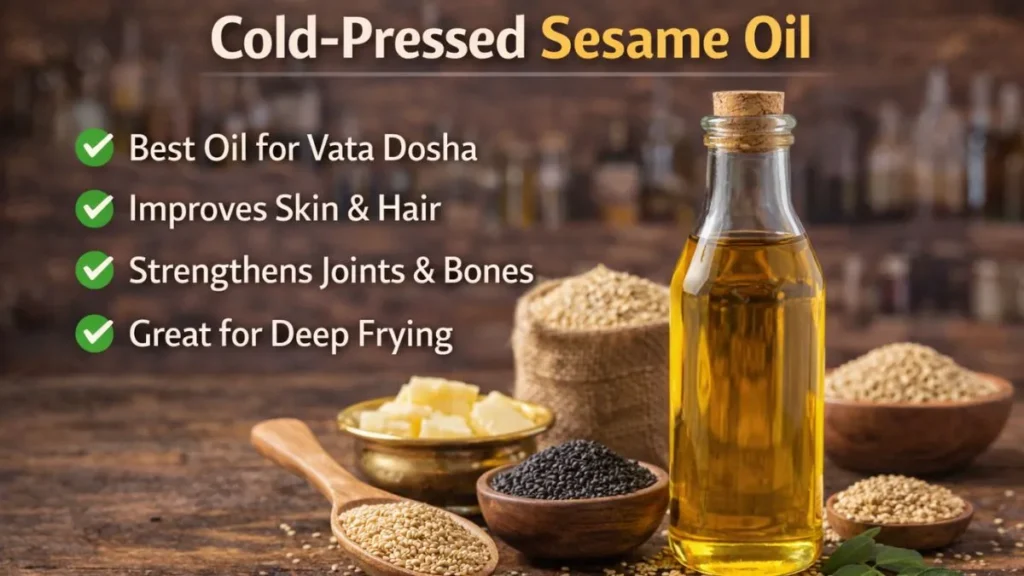
Sesame oil is called “Til Taila” in Ayurveda and considered the best cooking oil for Vata.
Benefits:
✔ Strengthens bones
✔ Improves skin & hair
✔ Reduces dryness
✔ Enhances memory
✔ Great for deep frying
Best For: Vata & Kapha
Avoid for: Excess Pitta (too heating)
(3) Coconut Oil

Coconut oil is cooling and extremely useful in hot climates.
Benefits:
✔ Supports thyroid
✔ Anti-inflammatory
✔ Anti-bacterial & anti-fungal
✔ Good for brain (MCTs)
✔ Boosts metabolism
Best For: Pitta & heat-related disorders
Avoid For: High Kapha (weight gain tendency)
Use: Low to medium heat cooking, raw on salads
(4) Mustard Oil
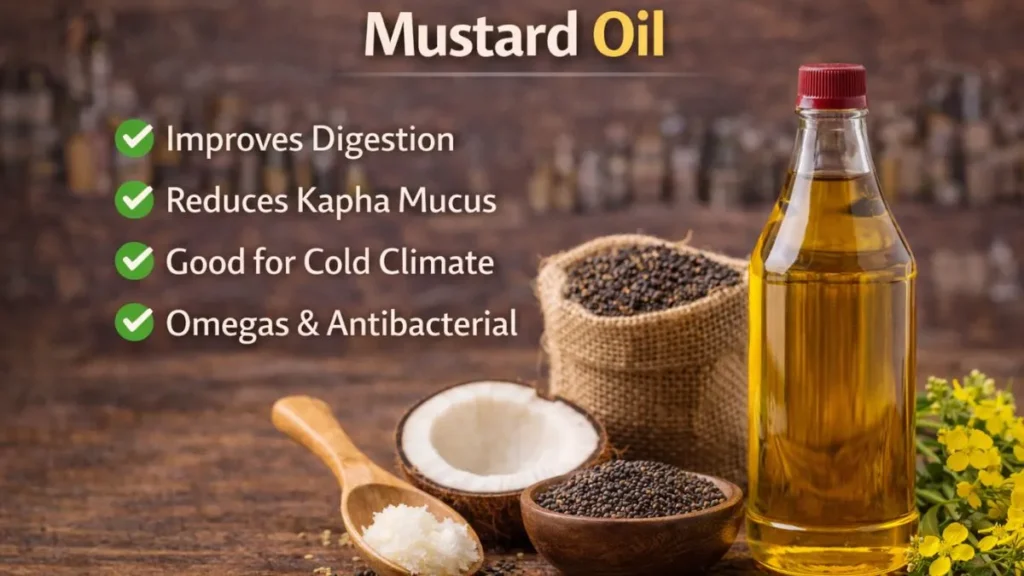
Mustard oil is pungent, warming, and circulatory stimulant.
Benefits:
✔ Improves digestion
✔ Good for cold climates
✔ Reduces mucus (Kapha)
✔ Antibacterial properties
Best For: Kapha & Vata
Avoid For: High Pitta (due to heating nature)
Modern Note: Contains Omega-3 & monounsaturated fats, better than refined oils.
(5) Olive Oil (Cold-Pressed Extra Virgin)
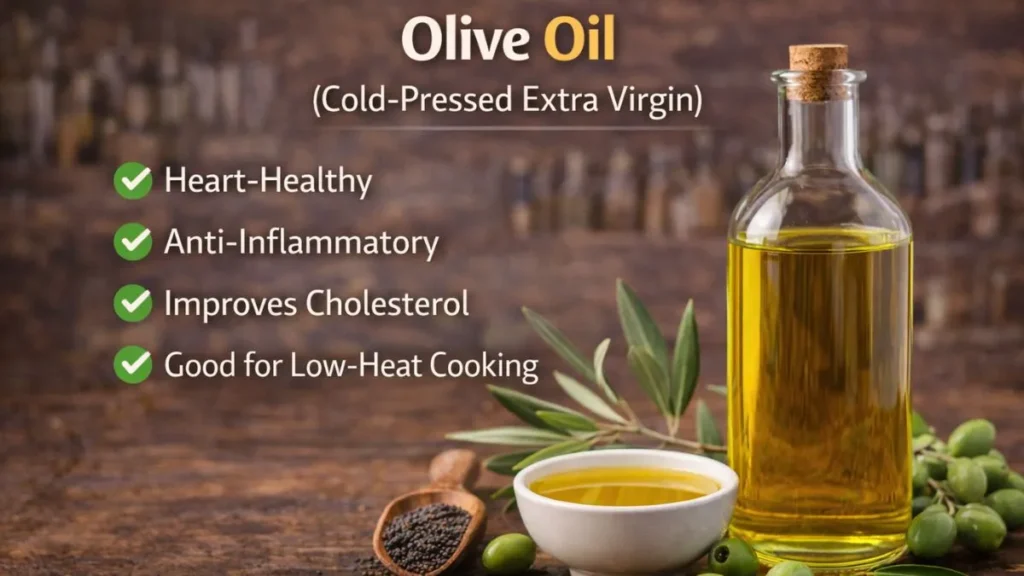
Good for heart and metabolism but not ideal for high-heat frying.
Benefits:
✔ Heart-friendly
✔ Anti-inflammatory (polyphenols)
✔ Improves cholesterol profile
✔ Good for ketogenic diets
Best For: Pitta & Vata
Use for salads, sautéing, not deep frying.
(6) Groundnut Oil (Cold-Pressed)
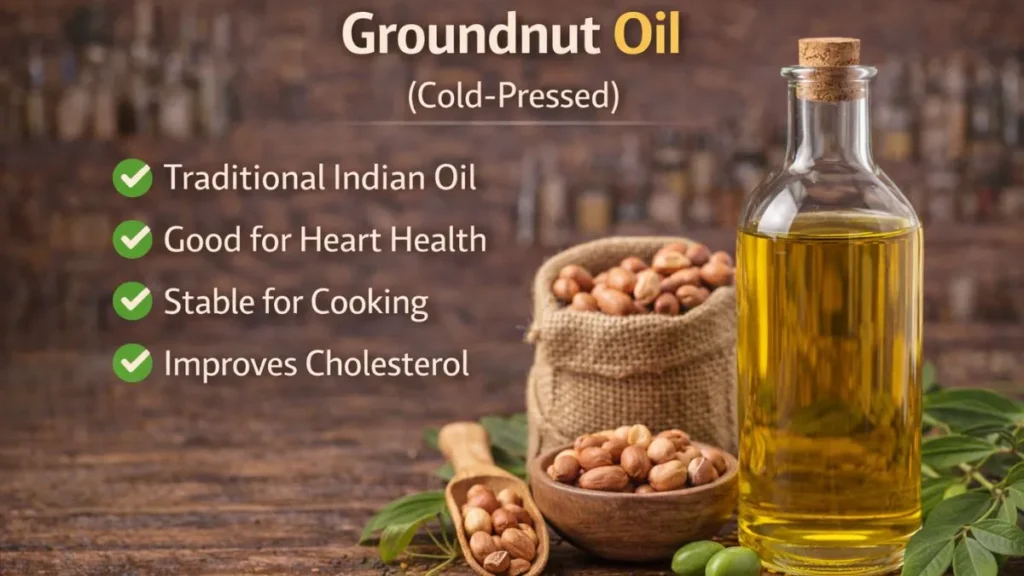
Traditional Indian oil, better tolerated than seed oils.
Benefits:
✔ Good balance of MUFA
✔ Stable for cooking
✔ Supports heart health
Best For: Vata & Pitta (moderately)
Oils Ayurveda Warns Against
Ayurveda does not favor highly processed or chemically treated oils, especially:
❌ Refined Sunflower Oil
❌ Refined Soybean Oil
❌ Refined Rice Bran Oil
❌ Refined Canola Oil
❌ Refined Corn Oil
❌ Vegetable Oil blends
❌ Margarine / Hydrogenated Oils (Trans fats)
Why to avoid?
✔ Increase inflammation
✔ Damage arteries
✔ Disrupt hormones
✔ Cause obesity & diabetes
✔ Increase bad cholesterol (LDL)
✔ Promote fatty liver
Modern science now agrees—refined seed oils are a major cause of lifestyle diseases.
Which Oils for Cooking & Which for Raw Use?
Best for Deep Frying (High Smoke Point):
✔ Ghee
✔ Cold-pressed Sesame Oil
✔ Cold-pressed Groundnut Oil
✔ Mustard Oil
Best for Low Heat Cooking:
✔ Olive Oil
✔ Coconut Oil
Best for Raw Use (Salads):
✔ EV Olive Oil
✔ Flaxseed Oil (Cold-Pressed)
✔ Coconut Oil (Raw)
✔ Ghee (Warm)
How Much Oil Should You Consume Daily?
Moderation is essential.
Ayurveda recommends:
👉 3–5 teaspoons (15–25 ml) per person daily
Varies by body type:
- Vata: More oils
- Pitta: Moderate
- Kapha: Less oils
Ayurvedic Rule: Rotate Oils Seasonally
- Winter: Sesame + Mustard + Ghee
- Summer: Coconut + Olive + Ghee
- Monsoon: Mustard + Ghee
This prevents dosha imbalance.
Signs You Are Using Wrong Oil
If your cooking oil is harming you, you may notice:
❗ Acidity
❗ Bloating
❗ Weight gain
❗ Indigestion
❗ Joint pain
❗ Excess heat
❗ High cholesterol
❗ Heartburn
Switching to Ayurvedic-approved oils fixes these issues naturally.
Also Read: Digestive Issues? Fennel Seeds Will Fix It Fast!
Conclusion
Choosing the right oil is not just a dietary choice—it is a lifestyle and health decision. Ayurveda provides a clear roadmap:
✔ Prefer natural, cold-pressed, unrefined oils
✔ Use oils that suit your dosha, season, and climate
✔ Avoid chemically refined, deodorized seed oils
✔ Use Ghee, Sesame, Coconut, Mustard, Olive oils wisely
✔ Rotate oils for optimum balance
When you align your oils with Ayurveda, digestion improves, inflammation drops, heart health strengthens, and hormonal balance returns. Ayurveda gives the final answer clearly:
👉 “Eat oils that are pure, natural, and in harmony with your body’s constitution.”
FAQs
Q1. Is ghee better than refined oil?
Yes, ghee is natural and supports digestion, while refined oils cause inflammation.
Q2. Which oil is best for heart health?
Extra virgin olive oil, mustard oil, and ghee in moderation.
Q3. Should we avoid refined oils?
Yes, due to chemical processing and health risks.
Q4. Is coconut oil healthy?
Yes, good for thyroid, metabolism, skin, and digestion.
Q5. Can we fry food in olive oil?
Not recommended for deep frying; use it for salads or light sautéing.
Q6. Which oil is best for Indian cooking?
Mustard, sesame, groundnut oil, and ghee.
Q7. Can diabetics consume ghee?
Yes, in moderation. It helps improve insulin sensitivity.
Q8. Which oil increases cholesterol?
Trans fats and refined oils.
Q9. Is mustard oil safe?
Yes when properly heated (smoke point reached).
Q10. Can we use more than one oil?
Yes, oil rotation is actually healthier.

I’m a professional Ayurvedic food and wellness content publisher, sharing evidence-based insights on Ayurvedic nutrition, natural remedies, healthy recipes, lifestyle tips, and holistic wellness trends from around the world.